Showing posts with label games. Show all posts

Wednesday, March 18, 2026

Discovery Learning: ADOM Edition

This past weekend, I notched my fifth ADOM win with a Drakeling Elementalist who is now #2 on the high-score list. In preparation for today’s blog post, I also replayed a Tutorial game on a new installation to remind myself what tips the system provides to brand new players.


What I’ve been musing about is “Discovery Learning”, a buzz-phrase that leverages (in this case simple-minded) “common sense” thinking. In the extreme version, there is no formal schooling for kids. Let them explore and discover the world and learn “naturally” from nature. Natural – good! Artificial – Bad!


I don’t disagree that much can be improved about the seemingly artificial settings of today’s classrooms especially for kids who have lots of energy and are bouncing off the walls. But I don’t think Discovery Learning and doing away with formal schooling is the answer. It could work well for some people after they’ve had a decent foundation (acquirable in diverse ways). The media likes highlighting the college dropout who went on to found a tech company and become ridiculously wealthy. They don’t tell you about the tens of thousands of other dropouts who did not become billionaires or even millionaires.


In ADOM, the world of Ancardia has rules. The basics are provided in the manual, and I found the tutorial much clearer now that I have 70-80 games under my belt compared to the very first time when I was floundering around. Because I had experience with old-school CRPGs, ADOM wasn’t impenetrable, but many of the rules are “hidden”. I actually did okay getting to my first mid-game character within a dozen games purely through Discovery Learning. Characters die early and often in ADOM. I could sink hundreds or thousands of hours into the game and learn more nuances about staying alive and making further progress towards the end goal, or I could learn from experts who have already traversed the path. I chose the latter, and my enjoyment of the game increased by more efficiently getting over many of the otherwise frustrating barriers that would have killed dozens of characters.


The “natural” environment of ADOM is brutal. You might even say they are hostile to learning efficiently. While the tutorial gives you a “warning” when you first enter the Small Cave, you have no idea what that really means. And until you notice or understand how the hostile monsters are generated, you’ll bang your head against the wall trying to get through. You have no sense of how the difficulty level scales. You encounter monsters you know nothing about. You might get cursed or doomed and not realize why it happened and what it means for your character. You don’t know what talents or attributes are helpful and how they might be trained naturally. There is plenty that is hidden unless you know exactly what to look for. I’m not sure how many games it would have taken me to figure out that dropping a potion of water on a co-aligned altar blesses it, and that when you dip a scroll of identify into holy water, you can then read it (if your literacy is high enough) to identify all your items in a single swoop.


As a chemistry professor, the natural sciences and math are the areas I am most familiar with. Learning math or chemistry efficiently is very unnatural. If you had to figure it out from scratch, it might take you several lifetimes. (Also, failure is not always productive.) The accumulation of human knowledge has taken lifetimes – small bits of info passed down from teacher to student. The apprenticeship model has been true for a long, long time. It’s far better than having to discover everything from scratch through trial and error, but this one-on-one learning is inefficient and very expensive on a larger scale. I don’t like having forty students in G-Chem; I think I do a better job when I have five or ten or twenty. (At least it’s not four hundred.) But I recognize the efficiency of teaching a group of students. They can also help and encourage each other, which is a plus in my opinion.


Becoming an expert requires depth of knowledge and acquiring abstract schemas in long-term memory. Without books and teachers and some very effortful thinking on my part, I would not have the expertise that I now have in chemistry. I can’t imagine getting there through pure discovery. Of course, here I’m caricaturing Discovery Learning, and an advocate would say that no one is promoting pure “throw you into the deep end of the pool and you sink or swim”. They’d say the learning has to be guided. I don’t disagree. But the same advocates caricature current classroom practices, especially what is known as “explicit teaching” as inferior to discovery approaches, or “lecturing” as an artifice and therefore worse than a more “natural” approach. In reality, one balances multiple aspects when considering pedagogical strategies.


My current ADOM character is a level 13 gnome druid. I just made it to the High Mountain Village although I was not able to retrieve the waterproof blanket on the way because I understand how the Small Cave works. The fun in ADOM is that the dungeon layouts (and the game is a dungeon-crawler) are randomly procedurally generated, so each game feels quite different. Your character’s inherent skill set provides even more variation. I think this is my third druid (the previous two did not make it past level 10 before succumbing), and I’ve learned how to balance spellcasting with traditional weapons. I also now know that most animals are generated friendly, and switching my alignment to Lawful means that I have a reasonably good chance of completing the Rolf Quest and getting the ring of the master cat, provided I don’t die in the Pyramid or somewhere else. The balance of some discovery and some guide-reading, in my case, has led to maximum enjoyment. I still do bits of both when I encounter something rare (statues and artifacts) or exploring a different aspect of the game, and I wouldn’t do this any other way.


Sunday, January 18, 2026

ADOM Update

Nine months later, I’m still playing Ancient Domains of Mystery (ADOM). The character I was playing back when I blogged about ADOM did win, but with plenty of “scum saving” in between. It means that if my character died or did something particularly stupid, I simply restarted at the last save. While that’s not in the spirit of ADOM’s permadeath setup, I felt it was a good way to learn more of the game.


After the success of the hurthling archer (level 41), and subsequently losing several other characters in early deaths, my second character to win was a drakeling barbarian (level 35, 96 days in the Drakalor chain). There was also a little scum-saving so I could learn to deal with the strange effects of being cold-blooded. This made the Tower of Eternal Flames quest exciting and nail-biting and the final level was a little harder because my character needed to recover from the cold in the penultimate level. For both these wins, I avoided big boss Fistanarius, used a magic map, a wand of digging, and a wand of destruction on the levers. Both normal endings; I’ve never done an ultra-ending.


At this point, I decided I will no longer scum-save even if I have a promising character that makes it to the mid or late game. And many don’t. The next character who almost won, a human necromancer (level 39), died fighting Fistanarius. It was very close and I should have healed but thought I could withstand one more blow and Fistanarius was on his last legs. Then there was the gnome assassin (level 37), who got killed by the emperor moloch – I was doing well on the Filk quest up to that point. My third win, and my first with no scum-saving was a gnome priest (level 39); this is also my highest score at 14,747,264 points. Then there were two deaths (level 27 and level 31 characters) to Katharamandus, the stone dragon. I hadn’t gauged the difficulty because my hurthling archer didn’t have too much trouble completing the Rolf quest. That’s the one and only time I finished what Rolf asked.


I had my fourth win this weekend, with a little scum-saving because I had a dwarf chaos knight, which meant a very different game. I had lost several chaos knights in the early game, and when this one made it to the mid-game, I wanted to keep going. I fed the Demented Ratling six artifacts, but had hardly any wild boar encounters and no boar head so I gave up on that quest and decided it would be okay to finish as a most stupid follower of chaos. My character was very powerful (level 40) and I’ve never gotten so many artifacts. I easily beat molochs and balors on the final level. Because the strategy was different, I learned a lot in this last game.


At this point I’ve played 60+ characters, always randomly generated by Fate. Interestingly, of the top eight high scores (the finishers and the ones who made it to the mid-game), seven were female including all four finishers. Not sure why; a possibility is that I pay more attention to the Appearance stat and maybe my characters saw less corruption overall. I created my next character on New Year’s Eve, my first on a special day. Fate chose a male gnome wizard; he’s a bit boozy but maybe he’ll survive. And maybe he’ll thrive.


Thursday, May 22, 2025

Exploring ADOM

I’m thirty years late to Ancient Domains of Mystery, more commonly known by its acronym ADOM. Created by Thomas Biskup in 1994, it is a computer role-playing game (CRPG) that is often described as Rogue-like. There’s an irreverent but informative video that discusses this issue amidst a high-speed playthrough of the ASCII version of ADOM. While there are spoilers, they go by much too fast for you to remember any of them, so I wouldn’t worry about it. I’ve never played the original Rogue so I have no basis for comparison. The three features that stood out to me are that it is turn-based, the dungeons are procedurally generated, and there is permadeath – when your character dies, the game immediately records it and all you can do is restart from scratch with a new character.


Most of my experience with computer games was for a half-decade in the mid-to-late 1980s, sometimes referred to as the golden age of CRPGs with plenty of different designs with new spaces to explore. I was first hooked by Ali Baba and the Forty Thieves and got through Ultima V before life took over. In the last year, however, I have been rediscovering the cousins and close descendants of those early games. I’ve been surprised by delightful obscure gems such as Antepenult alongside well-known old classics such as the first Might & Magic.


The old CRPGs required patience. You had to grind your way through lots of fights to earn experience, gold, and better weapons and armor. You had to level up your spellcasters to access more powerful destructive and protective magic. The baddies and bosses got harder. You needed special items to access special areas. I don’t have the same patience now as I did forty years ago, but I am enjoying the discovery aspects of ADOM. There’s a huge world to explore (mostly underground since it is a dungeon-crawler) with tons of different items. You don’t know what’s around the next corner so you’d better be prepared to fight or run. There’s a sweet satisfaction with surviving a nail-biting encounter, discovering a strange new space, or coming across an item you’ve never seen before.


I think I’m on my tenth or twelfth character in ADOM, and only the second to make it to the mid-game stage. (You die early and often, which is part of the exploration.) My previous troll fighter reached level twelve and made it to Dwarftown but got killed shortly after, somewhere in the Caverns of Chaos. I currently have a hurthling archer that successfully completed many early quests that I’m quite attached to now, so I am save-scumming (allowing me to restart if something bad happens or my character is close to death). What’s a hurthling? It’s like a halfling, hobbit or bobbit. If you recognize any of those names, you’ll know that CRPGs borrow heavily from Tolkien and its D&D derivatives. In ADOM, mithril gear is better than regular gear made of wood, leather, or iron. It’s also lighter – and carrying weight matters! But there’s also adamantium and eternium. ADOM has no problem mixing genres.


While I had no idea what I was doing in the first several games, experimenting with different objects and strategies, now that I have mid-level characters, I would prefer to not go back to the beginning and grind my way anew. (I’ve always had Fate decide all aspects of my starting character rather than picking my own stats.) So alongside my natural experimenting within the game world, I’ve also started referring to Internet resources (such as the ADOM Guidebook). In addition, I’m watching my way through a very entertaining play-through on YouTube, where I’m pacing myself episode-wise so my character is roughly at the same level. I’m learning that ADOM is even bigger than I thought, and there are things you can do that I hadn’t even considered. I suppose I’m learning from the large community of those who had gone before me. Long-term players have played thousands of games over the years and built up a lore of knowledge.


It’s a bit (or perhaps a lot) like science – discovering the natural “laws” of the world around you, what you can do and what you can’t do. There’s the trial and error approach which I used early on, and there’s learning from the community of those who have trialed-and-errored a lot more and are sharing the results of their labor. Finally, there might be folks who have looked at the code and can say something about the “hidden” underlying rules. This is how we humans learn. Many before us have experimented directly, and the fruits of discovery have been passed down to us so we don’t have to reinvent the wheel. As a teacher, it’s an integral part of my job to pass down this knowledge in my field of expertise, which is chemistry. One thing I convey to students is that we can come up with abstractions to understand the underlying rules of chemistry. This includes mathematical models that powerfully allow us to make predictions of what will happen in a different situation; it’s like discovering the source code of nature!


Yes, I could try to “enjoy” grinding my way through ADOM with no outside references. But I think the exploration is enhanced by tapping into the wisdom of the community while being careful to avoid spoilers. Without it, I think I would just give up – ADOM is a hard and unforgiving game. But games also allow you to explore the paths not taken, and ADOM’s many different starting characters and strategies, and its multiple endings (from what I’ve gleaned without looking at any of them in detail), provide a certain satisfaction. The procedurally-generated dungeons add to the game’s high replay value. For someone with my old-school 1980s CRPG background, ADOM provides an exploration experience at its finest. Warts and all. My character recently grew horns due to increased background corruption. That was yet another recent surprise with reaching the mid-game!


Saturday, March 8, 2025

Rediscovering Earth

Captain’s log, 25.04-05 in the year 4620. We’ve found the planet they call Earth in the Sol system of the Pythagoras cluster. There are no signs of life but we will try to find the underground station.


I’m playing Starflight, released in 1986 for the IBM-PC. The four-color CGA made it hard to distinguish terrain types, and I found it challenging to use the controls via the emulator on my laptop. After a bit more research, I found a “cracked” Amiga version that doesn’t require using the copy-protection codewheel every time I leave starbase. Also, the expanded color palette is very welcome, and the controls were more streamlined. Except for space battle where I still don’t know what I’m doing and randomly shooting at enemy craft.


Starflight is impressive. I’m amazed how much game they were able to pack in given memory and disk constraints. You start out as a starship captain from the Arth system, hire a crew, and explore the galaxy. The galaxy is huge! All those little circles represent solar systems, each of which may have multiple planets. There are more hidden in the green blobbed nebulae.


I don’t know what the object of the game is yet. Starting out, I needed to make some money to improve my ship and train my crew. To do that, mining is the name of the game. I was told that the innermost rocky planet was a good place to start prospecting so that’s what I did. Then I decided to explore the third planet and found strange artifacts such as a blue bauble, a silver gadget, a bladed toy, and strange cloth. There were ruins and a message telling me about a black egg. Also, there were strange creatures. And despite the simple graphics, the game gives you the feeling that you are indeed an explorer. It feels like you’re in Star Trek exploring strange new worlds. Even the silhouette of my starship reminds me of the Enterprise. Except mine’s much smaller and only has six crew members.


Not only is the galaxy large, planets are sizeable areas to explore in one’s all-terrain-vehicle. You pick a landing site and then drive around the local area grabbing minerals and specimens of the local fauna and flora. Sometimes there are ancient ruins where you load up on endurium, fuel for your starship. As a chemist, I’m delighted to read the chemical composition of the atmosphere, hydrosphere, and lithosphere of each planet I visit. We note the climate and the gravitational field, and determine if it’s suitable for colonization. If so, we log the planet and gain a reward upon returning to starbase, which is also where we sell our minerals and specimens, upgrade our ship, visit the bank, and if needed, hire crew replacements.


Then I ventured outside the Arth solar system. The nearby system is a K-class star, slightly unstable, apparently. On one of the planets I find a message asking me to report to another planet in a different system but the message is cut off. Clues lead to more clues, and in the meantime, the message board at starbase suggests that things are amiss. The sun of Arth is dying. Other ships were destroyed by androids. And as I venture further into outer space, I encounter aliens! The dialogue system is in real-time and you need to keep your wits about you. Do I try to be friendly? Do I raise my shields and prepare to fight? These encounters are tension-filled and even nerve-wracking, and you can be destroyed quickly by superior foes.


I’ve now learned a little more history from some of these encounters. A long time ago there was an old empire, but as starfaring expanded, different alien races encountered each other, and war often broke out. But now something is beginning to threaten all of life. There is no longer any life on Old Earth. It might be a race against time but I don’t know what to do yet.


Interestingly, Pluto is not a planet in Sol. At the time Starflight was released, Pluto had not yet been downgraded into a dwarf planet. Mars is mineral-rich and there was a polar station but it has been long deserted. In the meantime, I’ve made some friends and made some enemies. My ship is pretty formidable and I’ve got a good crew. I’ve picked up some useful and interesting alien devices and I have a reasonable guess of what I might need to do to prevent galactic destruction, but I need more specific information. Meanwhile the price of endurium is going up as people look to flee for safer havens. But for now, I’m elated that I rediscovered Earth!


Sunday, December 22, 2024

Enchantasy

I’ve been on a retro-gaming kick lately. Maybe it’s a nostalgic desire for when I was young, carefree, and had plenty of time to explore and ponder Ultima IV, which I revisited almost thirty years later. Another decade passed and in a second wave of nostalgia, I finally plunked down a little money during a sale to play Nox Archaist. I enjoyed it. Well-designed, well-paced, a good main-line quest with multiple interesting but not crucial side-quests, and the designer had streamlined gameplay – cutting out tedious parts and smoothening out flaws.


This year I stumbled upon the CRPG Addict blog and that led me to Antepenult, an obscure shareware game from the 1980s. It has its clever bits but also many flaws, but I still enjoyed it overall. Then the CRPG Addict started playing Enchantasy, another obscure shareware game (by Rick Abel, 1993). I waited until he finished to see his final rating, and I deemed it worth a try. Now that I’ve finished it, I think it’s better than Antepenult. While it shares similiarities to some of the Ultima games, I wouldn’t call it a clone. It had a different feel overall, and I enjoyed most of the game except the last stretch of the mainline quest felt tedious. I completed all the side quests, and the early ones were fun. But at some point, when my party of adventurers got a little too powerful, combat was just tedious. It was a while before I figured out that you could move and attack diagonally, and that you could explore the coasts and rivers with a boat. I would have avoided lots of tedious combat that way and my party would not have levelled up as quickly.


Good parts about the game: The interface was clean and easy to use. Having a map of the world was nice! The graphics were functional and over time I grew to like them better than the Ultima iconography. Early combat was a nail-biter and I enjoyed the early leveling up and skill-training. Conversations were guided and the NPCs emphasize the main point they want to get across. The world felt more interesting even with the generic find-magical-item and defeat evil main storyline. Each town felt unique. There were different grades of potions, weapons, and armor, including some interesting equipment. Monsters leveled up so that combat stayed interesting for a good chunk of the game. There was an interesting system where you had to know the names of some people before they would let you into their house and give you information. I took copious notes in this game, much more than in Antepenult or Nox Archaist. I also enjoyed visiting the Portsmith library!


There were houses off the beaten track, some had murdered people in them so there was a mystery as to who was killing them.


The caves and dungeons were straightforward to map and each had interesting features with secret passages and the like. The side quests were offbeat, and some of them quite amusing. I got to summon a white whale.


There was an abandoned alien base with a lonely robot who got left behind and wanted to be helpful.


Bad parts about the game: The early economy is very, very tight and I’m not sure I would have survived without the slot machines – a very incongruous feature of the game. It felt wrong to essentially rob every house or building I came across early on; I’m not sure if that was the intention. In the last bit of the game there seems to be needless running around from one town to another fetching items to give and receive to progress on your quest. After the excellent buildup in the early stages of the game, this last stretch felt tedious. It wasn’t until the end that I realized how unnecessary many of the side-quests were, even though I found the early ones fun and interesting.


There was a fun little end-sequence after the big boss battle. The game looked set up for a sequel. Like in Antepenult, an evil character gets away and lives to fight another day.


There was a nice celebratory victory where the people of the land congratulated and thanked me for saving them.


At some point, when I’ve forgotten the details I might replay it without the slot machines and using boats early, and perhaps not going through the cabinets and bookcases of the townspeople especially when they’re sleeping in bed and I’m rummaging their house. I went back and read the CRPG Addict’s entries and we did things in different sequences, although he finished the game in roughly half the time. Overall, it’s a good game and I enjoyed maybe a hundred hours of gameplay spread over two months. And the game kept me engaged for most of that time. I call that a win!

Sunday, November 10, 2024

Adventure Creation Kit

Two adventure-themed computer games I played back in the ‘80s had a unique style that I would call fast-and-furious in a mythological milieu. They were Ali Baba & The Forty Thieves and Return of Heracles, both programmed by Stuart Smith. While there were similarities to other adventure games, there wasn’t anything quite like them – strange and strangely addictive. Wandering creatures and NPCs (non-player characters) had a strange life of their own; they weren’t just there to interact with you. Sometimes they would fight each other for no seeming apparent reason while you picked up the spoils.


Like other kids who were exposed to computer games, I wondered what it would be like to create my own fun computer game. I had time on my hands. I learned BASIC by reading books in a bookstore or from the library and taking notes. I went to a friend’s house to practice my skills (because we didn’t own a computer). But all I could manage were some simple Lemonade style text-games. Then I discovered Adventure Construction Set, also by Stuart Smith. (Back in the day of pirated disks with no manuals I didn’t realize all these were by the same author.) It had a built-in game Rivers of Light, but I was most excited about making my own games. I gave up after a while. It felt very tedious.


After finishing Antepenult, I mused about whether I would create its sequel. Was there something out there like Adventure Construction Set but updated for the Ultima series? Turns out there was. Thus did I discover Adventure Creation Kit by Chris Hopkins, originally written in the ‘90s with patches up to 2009. I downloaded it and fired up DosBox. It has a tutorial and two-built in adventures. I ‘played’ the tutorial and the shorter Brigands adventure. Then I read the manual. It looked like quite a robust engine which supported BASIC-style macros that expanded all manner of things you could potentially do. It also had an Ultima V tileset. If I’m going to create an Ultima-clone, I might as well just use the tileset.


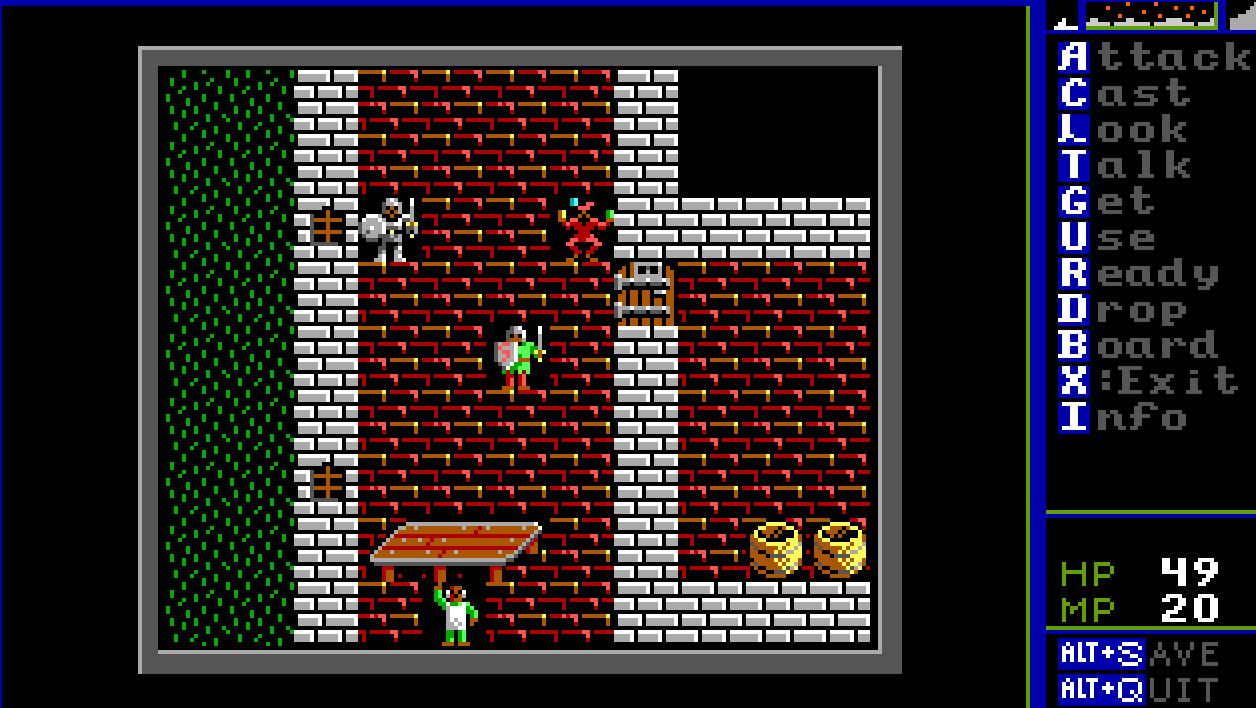
After creating a sandbox and playing around with it for several sessions, I felt ready to create my first game. It featured a 64 x 64 world map, three towns (one medium 32 x 32 and two small 16 x 16). The fifth map was a series of a dozen interconnected dungeon-style rooms. There were over 25 separate dialogues and I created some new icons for characters and some new special items. Creating the game took me 10-12 hours. I made it for my spouse who had never played such adventure games before but has heard me reminisce about them. Here’s a screenshot at a shoppe in one of the towns.


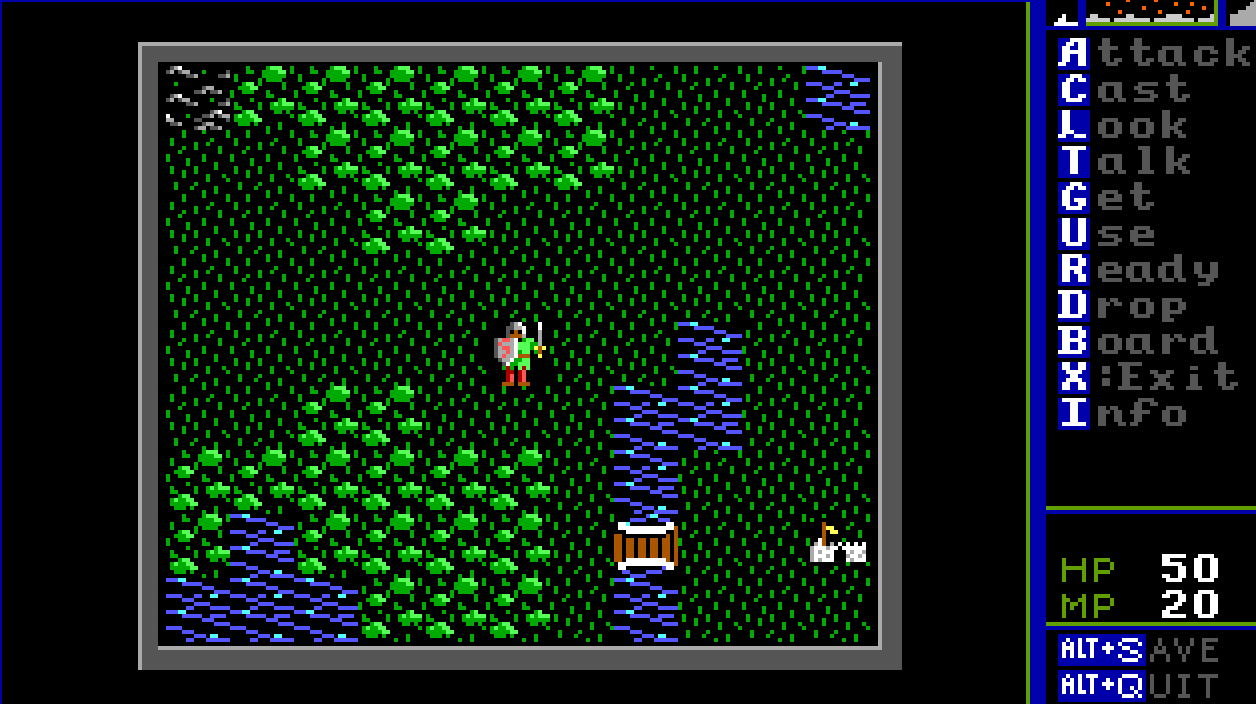
Adventure Creation Kit has a reduced command interface compared to Ultima, helpful to the new player, and these are listed on the right-hand panel. Dialogue with the townsfolk allows for plenty of interesting options, but I haven’t figured out if the dialogue can be scrolled rather than the screen-clear with each new prompt. There is no party – just the sole adventurer (like both Ultima II and Antepenult) which simplifies things such as no additional combat screen. Spellcasting utilizes simple generic reagents but it looks like I can modify how these work through macros. Here’s a picture just outside the start town.


It was interesting to see how my spouse interacted with the system. Things that were obvious to me as someone who played these types of ‘80s games were not at all obvious to her. She found the iconography unfamiliar. I advised her to ‘Look’ at anything she wasn’t sure of. She was also initially confused by the world-map wraparound. I had an NPC hint that the “world was small and round” but she didn’t quite get the reference. Eventually she figured out how to navigate around, but she went through great lengths to avoid combat unless it was inevitable. I did help her get suitable weapons and armour at the shoppe.


Even though an NPC had told her to be careful of the poisonous marshes and their ‘pink flowers’ outside, she still blundered into it and her character got poisoned. I had to direct her to go back to the shoppe to get a curing potion. (Her character hadn’t yet learned how to cast a Cure spell.) Again, this would have been obvious to me but I had forgotten to have an NPC explain it to a newbie. The original marshes tile did not have the pink tinge as you can see in the screenshot above. I had added those to the tiles to make them more obvious.


Overall, she enjoyed learning and playing the game, although I learned more just watching how she navigated the system. To me that’s a win and the hours I spent created the game were worth it. Clearly one should highlight keyword text in dialogues (I didn’t, but Nox Archaist did, which is extremely helpful to new players). It also made me aware of some odd issues in the game such as line-of-sight when dealing with opaque tiles and which regions of a map get illuminated. I have grandiose ideas of creating an Antepenult sequel but it would require much more time and effort, and I don’t think she would play it. I looked around to see if there is an active community still using Adventure Creation Kit but I haven’t come across it. I expect to play around with the kit a little more, but I think what is needed is a more modern base code. So if anyone out there who likes programming wants to create a modern version of the kit, I will be happy to write some (hopefully) engaging Ultima-style adventures!


P.S. To learn more about the Stuart Smith style, I highly recommend this article by the CRPG Addict. I think it does a great job capturing the essence of Smith’s games.

Sunday, October 13, 2024

Antepenult

Antepenult is an obscure Ultima clone, created for the Amiga in the 1980s by Paul Falstad, and distributed as shareware. This summer, I learned about it by stumbling onto the CRPG Addict blog; the writer Chester Bolingbroke is playing his way through old computer games in the role-playing-game genre. He’s an excellent and engaging writer, and my quick skim of his first two articles convinced me that I should give it a try. I did not read these closely so I would avoid detailed spoilers. After all, the fun part is solving the puzzles for yourself!


Unlike Nox Archaist, which pays homage to the Ultima series, but is much more streamlined with modern design sensibilities, Antepenult is indeed a child of the 1980s. And it really is an Ultima clone – down to most of the graphics and much of the gameplay. I’d classify it as a mishmash of Ultima II, III, and IV. You’re a single player; there is no party. You consume food. There are basic weapons, armor, and supplies (torches, keys, gems). You can obtain other special items, some of which provide the equivalent of magic. You get gold by fighting the same denizens you’d see in Ultima. It feels very familiar. You begin near a castle and a town; and the ruler of the castle sets you on your quest. Basically, you need to conquer evil and save the world. Nothing new there.


You begin in the land of Havilah. If you’ve read the bible, some of the non-player characters (NPCs) have biblical names, some are the early church fathers, and then there’s a whole bunch of Greek mythology thrown in. I met Homer and Asaph in the same hallway of a city. They were composing songs and poems about the evil that had come and my eventual victorious quest. To complete said quest, I needed to explore different towns and worlds and talk to NPCs. I was given a list of items to collect, and many of the NPCs strung me along by telling me the next person to talk to. The four elements of Earth, Water, Air, Fire, feature prominently. I had to discover how to access these different worlds. And if you guessed it, the waterworld is called Atlantis and its king is Neptune. Two towns in that world were Tyre and Sidon. Yes, it’s a mishmash. And the special items you collect are Ultima-cloney. I won’t say much in case you ever want to try the game yourself.


I’d never used an Amiga before but I was able to eventually get FS-UAE working several moons ago. So as not to interfere with my workweek, I only played Antepenult for some number of hours each weekend. I took copious notes and I started to make maps. When I really got stuck, I would skim the CRPG Addict’s articles and get a clue as to how to proceed. This didn’t happen very often and it has been interesting to compare Bolingbroke’s play-through with my own. We used similar strategies overall, and occasionally got stuck in the same spaces. But any seasoned old-school Ultima player would probably do the same things. Some patience is needed. A teenager today would probably find it b-o-r-i-n-g. But someone who played Ultima as a teenager will feel the nostalgia when discovering some clever and amusing parts in the game.


Here I am at the final castle of the big bad boss.


After defeating him, instead of getting a “Congratulations! You won!” message, I got confused as fire and black spots suddenly started appearing and I wasn’t sure what to do and whether I needed to run out of the castle. Everything goes black.


I wake up in a restored castle Pergamum and as I walked through the hallways I am thanked by its many inhabitants for saving the world. Asaph was one of them. As were a number of the church father namesakes who gave me clues for my quest. One character who I saved from a high school in hell sets up a possible sequel. (I thought I killed the hag, but apparently she got away. I must have just killed the daemon inhabiting a body that claimed her name.)


The king of Havilah, Lord Hypnos, tells me how to return to my own world. Very Ultima. When I enter the portal to do so, there’s an amusing sequence at the very end. Another hint of a possible sequel. No sequel ever came. According to Bolingbroke, this was Falstad’s only game and he programmed it when he was young, and before adulting became a fulltime job.


I’ve now read in detail all Bolingbroke’s Antepenult articles. If you’d like to just get a sense of the nostalgia by living vicariously through his playthrough, you won’t be disappointed by his articles. If you want the full experience, get an Amiga emulator and give it a go. My copy was unregistered which makes the game harder when you’re in Tartarus, but not insurmountable. In his articles, Bolingbroke provides enough information whenever you’re stuck. My overall rating of Antepenult? It’s not as good as Nox Archaist, but it has some very clever bits. When I finish my adulting phase-of-life, maybe I will take up writing a retro-game themed on the four elements. I have imagined some of my own clever bits. Maybe my game will be the Antepenult sequel.

Saturday, July 20, 2024

Tech Tree

In the 1980s, I discovered Civilization, the boardgame (Avalon Hill), and saved up enough money to buy the game. I had always been enamored reading about ancient civilizations, but to be able to rule one of them and decide its fate was a revelation! You had to manage the economics of trade and war, keep your citizens fed, make alliances, undermine your enemies, and gloriously advance in the technology tree. It was probably my first encounter with the tech tree in a game and I loved it!


I still have my old copy of Civilization. It has sat unplayed in a box for some three decades or more. (I also have a pristine copy of its expansion, Advanced Civilization, that I snagged from a game store going out of business in the early 2000s. Computer and video games were ascendant; board games were only just beginning their rebirth.) But the problem with Civilization, the boardgame, is that to truly shine you needed to find six other players willing to spend 10+ hours to play what seems like an archaic boardgame. I’ve since played many other 2-4 hour games with decent tech trees (such as Through the Ages), but they don’t quite have that same heft as their progenitor.


Civilization the boardgame was also the inspiration for Sid Meier’s Civilization, the computer game. I was no longer playing computer games in the 1990s, partly because I didn’t own a computer (laptop or desktop) until I started my job as a faculty member and I certainly wasn’t going to use my office desktop to play games. When my brother gave me his old ThinkPad, it had Civilization installed. I enjoyed several games at the easy Chieftain and Warlord levels. But because I didn’t have the manual, I didn’t know how the tech tree worked, and I had no focused strategy. I built up my cities, warred with neighbors, and advanced higgledy-piggledy through the tech tree, choosing what I think sounded good at the time. I didn’t understand how the scores were calculated, and I never changed my tax rate. It was somewhat fun to win at the lower level, although my winning percentages were never very high. After a few losses at a higher level, I gave up.


Fast-forward twenty-five years. I am rediscovering old computer games that are free to download and run on an emulator. I still can’t find six other human players willing to devote gobs of time to a Civilization boardgame. I decide to read the Civilization manual and look at the tech tree for the first time. I was hooked. With fresh eyes, the game looked much more interesting and I learned many things I didn’t know and mostly didn’t remember. Time to give it a whirl.


I romped through my first game at Chieftain level. Then I proceeded to win a couple of games at Warlord level, with higher percentages, but still not great. Then I moved on to Prince level, and then realized that I could get much higher scores by focusing on conquering the world as soon as possible. I always played with seven civilizations so it takes a while to find them all and do this. But how could I do this as efficiently as possible? I started to realize for the first time, that the strategy is not to advance too far in the tech tree. I needed to quickly get The Wheel to build chariots, Mathematics to build catapults, Writing to build diplomats, and Navigation to build sailing ships. At higher levels, I needed to build temples to keep my populace content while I built up a massive army. Previously I always prioritized Pottery to build a granary (just like I would in the boardgame).


At King level, I started to break the 100% rating. In my third game, as the French, and being fortunate to start with two settler units, I was able to remain as a Despot and conquer the world in 580 A.D. for a final score of 1642 and a rating of 131%. The only problem was that I mostly ignored the tech tree. Could I get a higher rating by shifting to science and focusing on Future Technologies? Since I had saved the game just before my military victory, I decided to resume at that point without conquering the hapless Babylonians who were down to their last city on a small island, and I had their city surrounded by diplomats. I switched to prioritizing science, switched governments to a Democracy, built the largest spaceship possible, but the plan was not to launch it but march through Future Technologies until close to the end-year before sending out my spaceship. It was really, really boring. I was essentially building and selling Courthouses and SDI Defense systems almost every turn. I finally caved and launched my spaceship, finishing the game in 1885 A.D. with a final score of 2293 and a rating of 183%.


It was time to try Emperor level. I was unable to finish the first game because of a glitch in the game where even though I conquered all the civilizations, the game didn’t end because a civilization likely got destroyed before it built its first city. I discovered this glitch in an earlier Prince-level game. Yes, I could have gone for the highest score ever with a future technology approach, but it would be too boring. Instead I played a second game, and as the Chinese, I was able to win in 1340 A.D. with a final score of 1532 and a rating of 153%. Wiser than Solomon apparently. But the game itself was a grind. The joy of the tech tree had been lost, and while I enjoyed being extremely efficient in having lots of small cities to keep up production, it became less interesting. I don’t feel attracted to trying the sequels to Sid Meier’s original Civilization. I’m an old-school computer gamer used to simple blocky graphics and not too many options. Maybe I’ll find something that’s in my sweet spot, and at least Sid Meier’s original scratched the itch of not having played the boardgame in a long, long time. But I do miss the tech tree!