Tuesday, August 20, 2024

Last Ditch?

I have regularly contemplated ditching the textbook in the classes I most regularly teach – the year-long sequence of general chemistry and physical chemistry. In my first year as a new faculty member, I used the books the department had been using. We have multiple sections of general chemistry, and the instructors decide as a group which textbook to use. There is only one section of physical chemistry, however, giving full freedom for the sole instructor to switch books.


My general rule is that I should use a textbook at least twice before deciding whether to ditch it or keep using it. The first year I use a new textbook I’m just getting used to it. I should not be too quick to write it off unless it seems like an utter disaster. And I would not pick an utter disaster in the first place. In P-Chem 2 (Statistical Thermodynamics), I went through three textbooks giving them two years each. While each textbook was subsequently better than its predecessor, none was a good fit with the way I wanted to teach statistical thermodynamics. (All three were “standard” P-Chem textbooks used at many universities.) Hence, I did my first ditch and switched to creating worksheets and problem sets. Many years have passed since and I’ve been happy with my decision to ditch.


That third textbook worked well for my approach to teaching P-Chem 1 (Quantum Chemistry). They even had a standalone version of the textbook for the semester-long course, rather than the full year of P-Chem. I used it for years. But two years ago, I decided to rearrange some content so I could incorporate modern valence bond theory and also introduce hands-on electronic structure calculations during class sections. Since my worksheets had worked well for P-Chem 2, it was a good time to ditch the textbook for P-Chem 1. I converted my lecture notes into similarly formatted worksheets. I like the new arrangement but it still needs tweaking. There’s always room for improvement!


For G-Chem, there are more constraints to making textbook changes because it is a group decision. And when you are running more than ten sections of the course, this also means a diversity of opinions from the many instructors. I think we’ve used four different textbooks in the 20-25 years I’ve been at my current institution. But in the last several years I’ve become increasingly disillusioned with the present textbook and, for that matter, any online homework management system (which I feel has unfortunately become the driving force in textbook adoption). So this coming fall I’m breaking with tradition and will ditch the textbook. Since I will be teaching the small honors sections of both G-Chem 1 and G-Chem 2 this coming academic year, there will be little disruption with much fewer students switching sections. At least that’s my hope.


My plan is to use an open access textbook as a resource. It’s a decent book and covers the content reasonably well, though not as good as the very best commercial texts out there. I will supplement these with Course Notes for each class. It will take time for me to generate these extra materials, but I think it’s worth the effort. I introduced Study Guides a couple of years ago in G-Chem, and I think these have worked well based on student feedback. They are still being tweaked as I re-work the material in this new iteration of G-Chem. I will retain most of the topics following the usual sequence, with a few minor changes. We’ll see how it goes. If it works well, this might be the last ditch where textbooks are concerned! (Unless I get to teach biochemistry again, and I’ll have to decide what to do then.)

Sunday, August 11, 2024

Also Liked

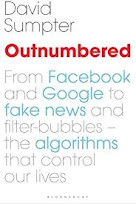
I’m in Part 2 of David Sumpter’s Outnumbered. There’s a discussion on superforecasters and how they continuously update their expectations by weighing and incorporating new information. Sumpter also compares the performance of prediction markets versus algorithmic crunching of polling data from FiveThirtyEight. There’s no clear winner. Crowd-sourcing sometimes helps, but sometimes leads you astray.


The chapter that most grabbed my attention analyzes the “Also Liked” effect, named after Amazon’s algorithm showing you that “customers who bought this item also bought…” or “you might also like…” It’s clear that users find this helpful to narrow down the plethora of choices which would otherwise be overwhelming. The fact that many other apps do the same thing underscores its effectiveness. The algorithm recommends. You’re welcome to ignore its recommendations, but let’s face it, most of us don’t want to wade through gobs of irrelevant stuff.


Sumpter runs a few simple simulations to see how these algorithms, over time, filter what you see and don’t see. The results are interesting. All it takes is a few early “likes” that make the appropriate connections to catapult something into the few vaunted choices that are displayed. That’s even true for a small data set. If you considered thousands or millions of products, the early advantages compound exponentially. Slightly-better-sellers become best-sellers in a self-fulfilling prophecy, algorithmically controlled. When you upvote a news story or website in social media, the upvote quickly cascades into more upvoting.


A related phenomena relevant to academia are citation statistics. Sumpter provides a data plot showing proportion of articles versus number of times they are cited. The data follows a power law (you see a straight line in a log-log plot). Sumpter writes: “Power laws are a sign of vast inequality.” When examining the data over time, it starts to resemble the “Also Liked” effect. The rich become richer in fame. The poor get relegated to obscurity. We now have the h-index (for authors) and the impact factor (for journals) and a vicious cycle ensues. But more broadly with respect to ubiquitous social media, Sumpter writes: “Inequality is one of the biggest challenges facing society, and it is exacerbated by our lives online."


From there, Sumpter moves to examine echo chambers and filter bubbles. There’s some interesting old data looking at political blogs from 2004 in the leadup to the U.S. presidential election that year. Democrat and Republican blogs linked nearly exclusively to their own writers with little cross-over. But all of them still linked to the same limited mass media. By 2016, this had changed. Mass media divided into and joined their respective echo chambers. But with the implementation of “Also Liked”, what you were presented when you logged on to social media became filtered more and more towards what you liked or what your friends liked. That’s the filter bubble. It also explains why conspiracy theories proliferate and gain steam. But a strange thing happens if the conspiracy theory becomes too popular too quickly. When enough naysayers and doubters “like” each other’s responses, their views can start to eclipse those of the original conspirators.


Sumpter presents analyses by Michela Del Vicario and her team looking at the echo chambers of scientists versus conspiracy theorists on Facebook. Both are echo chambers and filter bubbles. Most of the general population (at least in Italy) tune them out. The features of the posts are interesting. Analyzing the words, “the general rule is that the higher the activity of the user, the more negative words they use… the effect was stronger for scientists… and the more active they were on Facebook, the more negative they became. Becoming a dedicated member of an echo chamber is not a route to happiness.” Worse in my opinion: “Not only are conspiracy theorists less grumpy than scientists, their shared posts are also more popular than those made about science news. This is particularly worrying since many of the conspiracy theories are about science.”


The increasing isolation of individuals within modern society, and the speed at which the internet proliferates ideas, have made it very hard to stop and think. We’re too busy reacting. I used to “like” posts from Facebook friends, back when I used it. But if I ever get back to it, I might stop doing so. Instead, maybe I should spend more time making conscious choices about personal connections and not feed the filtering algorithms. “Also liked” seems like a boon, but it can also be an insidious curse.

Saturday, August 10, 2024

Data Alchemy

I’m reading David Sumpter’s Outnumbered on “the algorithms that control our lives”. Sumpter is an applied mathematician known for Soccermatics which I haven’t read, but I have read at least one of his research papers and found his writing lucid. I wanted to read more and Outnumbered was at my local library. Convenience was enough of a filter for me to choose easier access and being lazy. Sumpter will discuss filter bubbles later in his book but today’s post is on earlier chapters.


All the chapters are short and very readable; there are a few tables and graphs that aid the explanations. Sumpter begins by explaining how principal component analysis (PCA) works. But he does so with interesting examples such as Facebook friend connections and who likes what, and whether you can extract interesting data to build a composite profile. He tackles the Cambridge Analytica scandal head-on, and I found compelling his argument that it was mostly hyperbole. The targeted ads being placed by algorithms aren’t as effective as the tech companies (hungry for your money) say they are.


The chapter I learned the most from in Part 1 of his book is titled “Impossibly Biased”. Sumpter goes through the COMPAS algorithm used to assess if someone who commited a crime is at low or high risk of re-offending. There were claims and counter-claims of the algorithm being biased. But bias is in the eyes of the beholder. With some numbers and simplified examples, Sumpter explains why if you construct any two-by-two grid, it is “impossible to have both calibration between groups and equal rates of false positives and false negatives between groups” unless the two groups you study truly behave identically for a given question you are asking. There is a mathematical proof for this. Sumpter concludes: “There isn’t an equation for fairness. Fairness is something human. It is something we feel.”


The chapter I found the most interesting from Part 1 is titled “The Data Alchemists”. Some of his Soccermatics work comes into the story, but Sumpter also provides examples from Spotify and those seemingly creepy ads from Facebook or Google that seem to know you. There’s also discussion of a study comparing how COMPAS does versus volunteers on Mechanical Turk. Humans, not trained as judges, do just as well as the algorithm on average. As to what the algorithms might recommend to you, Sumpter argues that they work well on a group level, but not necessarily on an individual level. Yes, it does seem spooky when you receive a targeted ad that seems to “read your mind” but the algorithms aren’t so fine-grained. They aren’t decrypting your WhatsApp messages or recording your phone conversations. Sumpter says: “The more plausible explanation is that data alchemists arefinding statistical relationships in our behavior that help target us: kids who watch Minecraft and Overwatch videos eat sandwiches in the evening.” They’re correlations that may or may not have any clear causal connections.


Technology will continue to advance. These algorithms might get better. But they might not. One of the challenges of machine learning with large data sets with millions of variables is that we no longer understand exactly how these algorithms work. This also means that we don’t quite understand when and how they fail. Yes, we can put in band-aid fixes to reduce the symptoms of “bias” or “hallucination” but there’s no solution to the problem. Humans are not computers. Brains are not software neural nets. Manipulating data is what algorithms do. Interpreting those manipulations to make things “work better” (whatever that means) is still both science and art. As a chemist, alchemy is the appropriate word to describe it.

Sunday, August 4, 2024

Sustainability (with Data)

I’m reading Not the End of the World by Hannah Ritchie, a data scientist and communicator. The book leverages data analysis to strike an optimistic tone about “how we can be the first generation to build a sustainable planet”, the subtitle of the book. The influence of Hans Rosling can be seen in her work – while there are things that are getting worse for the planet and humankind, many things are also getting better. Each chapter comes with things we should be working on, and things we shouldn’t overly stress about. Ritchie doesn’t sugarcoat the data, but she interprets it in context.


She begins with the provocative idea that “the world has never been sustainable” making use of the United Nations definition of sustainability as “meeting the needs of the present without compromising the ability of future generations to meet their own needs”. Humans have been changing the world and its flora and fauna for thousands of years, be it through expanding agriculture or hunting larger beasts to extinction. But there have been many improvements in human health and longevity and improving standards of living. On the other hand, we’ve been gobbling up resources and it becomes questionable what we’re doing to future generations. Ritchie tackles seven problems: air pollution, climate change with temperature rise, deforestation, the food network, loss of biodiversity, plastics in the ocean, and overfishing.


I’m lucky to live in an area where the air quality is relatively good. When I was in graduate school in the ‘90s, folks who had lived in that same area in the ‘70s would tell me horror stories of the smog. The Clean Air Act in the U.S., implemented in 1970 and signed by Nixon (who also created the EPA, who apparently didn’t care about environmental issues, but who cared what voters and the public thought). Ritchie, based in the U.K., provides plots showing the peak of air pollution from the ‘50s to the ‘70s and how the emission of various gases and black carbon have plummeted approaching 18th century levels. Even China has passed its air pollution peak, and that wasn’t just because they hosted the Olympics. Ritchie discusses the need to provide access to clean cooking fuels, remove sulfur from fossil fuels, and end winter crop-burning (something I didn’t know about).


Climate change is tricky – you’d assume that everyone should just switch to “renewable” energy as soon as possible, but that’s not so easy because greenhouse gas emissions has multiple sources. There are trade-offs in each of these energy-hungry sectors. Three-quarters of our transport emissions come from driving on roads. I was surprised that shipping and aviation contributed only ten percent each. Electric vehicles help but there are tradeoffs; better still would be redesigning our cities and living spaces to reduce the use of cars. What caught my attention was food. Producing beef is an order of magnitude worse than chicken; plant-based proteins are even better. We also need to reduce overconsumption and wastage. I also learned that eating “local” or “organic” aren’t necessarily better. It depends. Ritchie provides both the data and the analysis.


Growing up in the tropics, I appreciated Ritchie’s nuanced discussion on deforestation and the protection of biodiversity. Yes, humans have cut down a third of the world’s forest mainly to make room for agriculture. But you can start to see the recovery at least in some “richer” countries. I remember the controversies surrounding palm oil some years ago. Ritchie tackles the health arguments and myths, but she also discusses the productivity of palm oil per hectare compared to almost any other common oil crops. Palm oil is more sparing in terms of land-use. The issue of beef comes up again because it’s particularly greedy for land-use where we’re growing crops mainly to feed the cows. Lamb actually takes a little more land use, but has lower emissions than beef. It was however heartening to see Ritchie’s data that the world may have passed peak agricultural land use and looks like it might also be reaching peak fertilizer use. Humans have been able to increase crop yields to feed the planet through a variety of strategies. Norman Borlaug gets several mentions.


On the topic of biodiversity, I learned from Ritchie’s charts that in terms of global biomass measured by carbon, plants are 82%, bacteria are 13%, fungi are 2%, and animals are 0.4%. Within the animal category, humans are 2.5%, livestock are 4%, and the largest shares go to fish at 29% and arthropods at 42%. Are we humans causing the Earth’s sixth mass extinction? Depends on how you look at it. Overall, biodiversity is decreasing but there’s a lot of variation. Some species are showing increases or recoveries; others continue down the path to extinction. And ecology is complex. You think you can do this one thing to affect this one thing, and then find out that there are many unanticipated knock-on effects. Ritchie also provides graphs showing the leveling of tonnage in wild seafood catch compared to aquaculture; and there’s also a bar chart on the carbon footprint for different kinds of fish. Apparently sardines have a very low carbon footprint. (Lobster and flounder are very high.) Tuna is a little better than chicken, and salmon does even better in this regard.


What I liked about Ritchie’s book is that it made me stop and think about the complex web of sustainability and ecosystems. I might even make some gradual lifestyle changes in what I eat, although as it is I rarely eat beef or lamb. For someone living in the U.S., my consumption of energy is relatively low and I buy very little outside of food. I won’t give up driving just yet (although my mileage per year is probably on the lower side). I could start composting and do a better job sorting my trash and not wasting stuff. I thought Ritchie did an effective job using the data to marshal arguments, and it’s something I could improve in my teaching to help students do so better. Ritchie’s book is a very accessible read and I recommend it.

Sunday, July 21, 2024

Inorganic Organism

In his book Material World, Ed Conway suggests an analogy modern-man-made physical structures today and a living organism. “If steel provides the skeleton of our world and concrete its flesh then copper is civilisation’s nervous system, the circuitry and cables we never see but couldn’t function without.” And what gives these structures life comes from harnessing the long-dead. Black gold, or “[crude] oil is the food that sustains… it provides us with energy, with the chemicals from which we make the fertilisers that keep [us] alive.” Most of our electricity is generated by pumping out hydrocarbons from the bowels of the Earth, just as we have dug iron, copper, gold and other “precious” metals through mining – creating huge pits in the ground.


I learned that the quality of iron is dependent on how much carbon is present. To make ultra strong steel, “too much carbon and the structure of the lattice is easily imperfect, so the metal can easily shatter. Too little and the iron atoms slide over each other without much resistance.” But before modern science understood this, there were protocols and recipes developed by trial and error. The Hittites may have won many battles with their superior weaponry. Conway tells the story of steel through agriculture and improvements made to the plough. Mao’s Great Leap disaster makes an appearance. The steelworks of Azovstal is also discussed, with its history and present woes amid battle with Russia today and with Germany’s Hitler in the past. I also learned that a byproduct of the steelworks was neon which resulted in Ukraine becoming a major producer of this noble gas!


It also turns out that since the Manhattan Project and the detonation of nuclear bombs, the atmosphere is contaminated by trace levels of radioactive isotopes. And because making steel requires “spraying oxygen (from the air) into the lava mix”, if you wanted to make something called low-background steel, you could only obtain it from sources pre-1945. Apparently, this is why old sunken battleships are a great source, the Perth (near Jawa) and the Repulse and Prince of Wales off the coast of Malaysia. I also learned that steel is quite recyclable. It’s mostly iron, and you can sort it easily because it’s magnetic. I learned that “more than two-thirds of America’s steel is now made from scrap… old skyscrapers and cars are reconstituted”.


The advent of electricity completely changed human life. Copper is a major contributor to this story, and I’m amazed at the ingenuity and perseverance of the scientists and engineers involved. Conway traces the history of mining starting with Cyprus (from where we get the name) to Rio Tinto to Sweden and to the huge hole in the ground in Chuquimata, Chile – “the mine that ate a town”. I was staggered reading the size of the mining operation and had to look up pictures on the internet. I would probably be overawed and aghast if I saw it physically in person with my own eyes. Conway spends some time discussing deep sea mining and polymetallic nodules and the UN Convention on the Law of the Sea. Coincidentally, I had just read about the Philippines and Vietnam’s applications to have its continental shelf extended, amidst squabbles with China over who has rights to what zones. And there’s the brazenness of copper thieves in major metropolitan areas of the U.S. Clearly the industrial hunger for this metal has not abated.


In the chapters on oil, Conway discusses the different varieties of crude oil (based on its sulfur content and density), the transition away from coal to oil, and the present transition to natural gas. And while there are many advances in renewable sources, making solar panels or wind turbines or better batteries; all these require energy. Lots of it. I agree with Conway that we will be using these fossil-fuel products for a long time to come, certainly in the near future. Unless perhaps there is a significant shift toward nuclear power. I learned a little about oil refineries (they’re a complex complex!) And Conway discusses the many byproducts of the petrochemical industry and the ubiquity of plastics. Inorganic materials give you a lot to play with, but organic materials open up the toolbox to make pretty much anything you can imagine.


Conway’s book is a great reminder that our way of life and technology sits upon the bedrock of a physical material world. And although the ethereal world of the Internet beckons for our attention, none of it can be sustained without the physical. If not for steel, copper, fibreglass, or plastics, we wouldn’t have the cloud services and apps and devices that we glue our eyes on. One wonders if we’ve become willing slaves to the feeding of a huge inorganic-organic structure known as the modern way of life with its air-conditioned server rooms filled with blinking lights and computer chips. Artificial intelligence, we call it. Let’s hope it doesn’t subvert our intelligence any further. Because it has a limitless appetite and we will keep digging the materials out of the ground to feed it.

Saturday, July 20, 2024

Tech Tree

In the 1980s, I discovered Civilization, the boardgame (Avalon Hill), and saved up enough money to buy the game. I had always been enamored reading about ancient civilizations, but to be able to rule one of them and decide its fate was a revelation! You had to manage the economics of trade and war, keep your citizens fed, make alliances, undermine your enemies, and gloriously advance in the technology tree. It was probably my first encounter with the tech tree in a game and I loved it!


I still have my old copy of Civilization. It has sat unplayed in a box for some three decades or more. (I also have a pristine copy of its expansion, Advanced Civilization, that I snagged from a game store going out of business in the early 2000s. Computer and video games were ascendant; board games were only just beginning their rebirth.) But the problem with Civilization, the boardgame, is that to truly shine you needed to find six other players willing to spend 10+ hours to play what seems like an archaic boardgame. I’ve since played many other 2-4 hour games with decent tech trees (such as Through the Ages), but they don’t quite have that same heft as their progenitor.


Civilization the boardgame was also the inspiration for Sid Meier’s Civilization, the computer game. I was no longer playing computer games in the 1990s, partly because I didn’t own a computer (laptop or desktop) until I started my job as a faculty member and I certainly wasn’t going to use my office desktop to play games. When my brother gave me his old ThinkPad, it had Civilization installed. I enjoyed several games at the easy Chieftain and Warlord levels. But because I didn’t have the manual, I didn’t know how the tech tree worked, and I had no focused strategy. I built up my cities, warred with neighbors, and advanced higgledy-piggledy through the tech tree, choosing what I think sounded good at the time. I didn’t understand how the scores were calculated, and I never changed my tax rate. It was somewhat fun to win at the lower level, although my winning percentages were never very high. After a few losses at a higher level, I gave up.


Fast-forward twenty-five years. I am rediscovering old computer games that are free to download and run on an emulator. I still can’t find six other human players willing to devote gobs of time to a Civilization boardgame. I decide to read the Civilization manual and look at the tech tree for the first time. I was hooked. With fresh eyes, the game looked much more interesting and I learned many things I didn’t know and mostly didn’t remember. Time to give it a whirl.


I romped through my first game at Chieftain level. Then I proceeded to win a couple of games at Warlord level, with higher percentages, but still not great. Then I moved on to Prince level, and then realized that I could get much higher scores by focusing on conquering the world as soon as possible. I always played with seven civilizations so it takes a while to find them all and do this. But how could I do this as efficiently as possible? I started to realize for the first time, that the strategy is not to advance too far in the tech tree. I needed to quickly get The Wheel to build chariots, Mathematics to build catapults, Writing to build diplomats, and Navigation to build sailing ships. At higher levels, I needed to build temples to keep my populace content while I built up a massive army. Previously I always prioritized Pottery to build a granary (just like I would in the boardgame).


At King level, I started to break the 100% rating. In my third game, as the French, and being fortunate to start with two settler units, I was able to remain as a Despot and conquer the world in 580 A.D. for a final score of 1642 and a rating of 131%. The only problem was that I mostly ignored the tech tree. Could I get a higher rating by shifting to science and focusing on Future Technologies? Since I had saved the game just before my military victory, I decided to resume at that point without conquering the hapless Babylonians who were down to their last city on a small island, and I had their city surrounded by diplomats. I switched to prioritizing science, switched governments to a Democracy, built the largest spaceship possible, but the plan was not to launch it but march through Future Technologies until close to the end-year before sending out my spaceship. It was really, really boring. I was essentially building and selling Courthouses and SDI Defense systems almost every turn. I finally caved and launched my spaceship, finishing the game in 1885 A.D. with a final score of 2293 and a rating of 183%.


It was time to try Emperor level. I was unable to finish the first game because of a glitch in the game where even though I conquered all the civilizations, the game didn’t end because a civilization likely got destroyed before it built its first city. I discovered this glitch in an earlier Prince-level game. Yes, I could have gone for the highest score ever with a future technology approach, but it would be too boring. Instead I played a second game, and as the Chinese, I was able to win in 1340 A.D. with a final score of 1532 and a rating of 153%. Wiser than Solomon apparently. But the game itself was a grind. The joy of the tech tree had been lost, and while I enjoyed being extremely efficient in having lots of small cities to keep up production, it became less interesting. I don’t feel attracted to trying the sequels to Sid Meier’s original Civilization. I’m an old-school computer gamer used to simple blocky graphics and not too many options. Maybe I’ll find something that’s in my sweet spot, and at least Sid Meier’s original scratched the itch of not having played the boardgame in a long, long time. But I do miss the tech tree!

Monday, July 15, 2024

Purifying Sand

There are many grades of sand. I’m learning this from Ed Conway’s Material World where sand is the first of “the six raw materials that shape modern civilization”. The story begins with glass. Pliny the Elder claims it was the Phoenician sailors and traders who, in the evening, “lit a fire on the beach, and in the absence of anywhere else to rest their pots, they perched them on some of the natron blocks”. Natron is rich in sodium carbonate, and combined with seashore sand and high temperatures, makes glass. Or at least a type of glass. There are many different types.


Glass is mostly silicon dioxide (SiO2), commonly known as silica. But it has a very high melting point, and will only melt in a simple open furnace if impurities such as sodium are present, because these impurities lower the melting point – as my G-Chem students have learned. But this also affects the quality and type of glass produced. Now if you can find sand that is over 95% silica, you can make useful stuff such as water filters, or you can make “the very clearest, finest glass”. There are some specific locations around the world, and Conway discusses a visit to Scotland to a rock mine with 99% pure silica. Conway then tells a fascinating story about the importance of field glasses (binoculars) requiring really high-quality glass and the key role they played in the first world war. Call it the early tech information support that is crucial! Nowadays we use satellites and drones.


Concrete is the second product of sand that Conway discusses. I had previously read about the Roman aqueducts and the discovery of Portland cement so much of this chapter was familiar. But Conway also discusses land reclamation projects all over the world, and I was staggered by how much earth has been moved both to make concrete for buildings, and to make new ground where there once was sea to place such buildings. I learned about governments playing cat-and-mouse with “sand mafia” gangs who would perform bloody murder to keep their illegal trade going. Conway also discusses new concrete-like materials that have a lower carbon footprint. Some are based on hemp. Some on graphene. And there’s even one designed to absorb carbon dioxide over time.


Most eye-opening to me was the production of ultra-pure silicon. It needs to be 99.9999999% pure to be nanocrystal-grade. You need it for your latest and greatest computer chips that are powering the A.I. revolution. Conway traces the supply chain, from raw materials, to multiple factory-industrial stages, before you get those Nvidia or AMD branded ones that are in high demand. The manufacturing process is so demanding that I was in awe of everything that has to go right when so many things that can go wrong. And these companies in the supply chain have perfected the techniques for mass production. They are all over the world and except for TSMC and ASML that have been in the news recently, I hadn’t heard of the many others that Conway listed. All of them are crucial cogs and the supply could easily be cut off. Scary, now that we’re so dependent on computer chips in everything.


Reading Material World reminded me of how I’d like to re-theme my G-Chem class to focus on materials. I haven’t figured out exactly how to do that yet, but I have some fresh ideas to chew on. Up next in my reading: Salt.